Humanity.wiki
An open platform for organising humanity's knowledge
Humanity.wiki maps humanity's challenges and tells you when it has no data
Since August 2026, Light Humanity has been developing Humanity.wiki, an open platform that brings together data, maps and knowledge about humanity's challenges to show, territory by territory, how far we are from solving them. It is at an early stage and warns that, for now, the figures on its map are simulated.
- What it is: an open platform for organising humanity's knowledge and seeing how each territory is faring against shared challenges.
- Where: at humanity.wiki and, since 5 November 2026, in Humanity.
- How: a four-level model, from goal to metric, which for water already reaches river stations; every figure must carry a source and date.
- With whom: it is led by Eugenio García-Calderón Huerta, founder of Light Humanity, with artificial intelligence assistants.
- Result: online since 7 August 2026, with six views of knowledge in Humanity and more than 2,300 changes to its public code on GitHub.
- What comes next: replacing the test figures with sourced data and opening up creation to more people.
The origin: rating politics against common goals and seeing it on a map
The starting point was a system for rating politics against common goals, with a map to show it all at a glance. Its About Humanity.Wiki page defines it as “a system for monitoring and improving the state of our territories through objective data, shared challenges and systemic solutions”.
- The question: how far each territory, from the planet down to a municipality, still has to go to solve each challenge.
- The scale: one score per common goal and territory. There used to be 14; today there are 15.
The problem: humanity's knowledge is fragmented
“Today knowledge is fragmented: the data in one place, the maps in another, the conversations in a third, and what each person knows locked away in their head or their Notion” — Humanity.wiki, “Vision and Roadmap” (humanity.wiki/vision)
- Scattered data: figures on water, food or housing are spread across PDFs, ministries and one-off reports, according to the project README.
- No territory, no origin: they tend to stop at national level and rarely say where they come from.
Humanity.wiki brings raw data, connected knowledge and place-based knowledge together on a single foundation.
Humanity.wiki is born in a week: from the planet to a river gauging station
The first code was saved on 1 August 2026 as “Humanity Evolution Platform”, based on an application created in Google AI Studio, according to its changelog.
- Four levels: goal, indicator, marker and metric. For water: quality, purity and nitrates, with measuring points on rivers such as the Ebro and the Tagus.
- From 6 to 15 challenges: on 3 August it grew to 14 goals, adding education, energy and culture; before the end of August, spirituality joined them.
- Down to the municipality: that same day, the 179 municipalities of the Community of Madrid were added, with their real boundaries.
- A name of its own: on 5 August it took the name of its domain, humanity.wiki, and by the 7th it was running there.
The Humanity Indicators Map gives fair warning: its figures are simulated
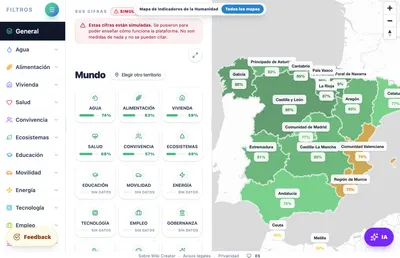
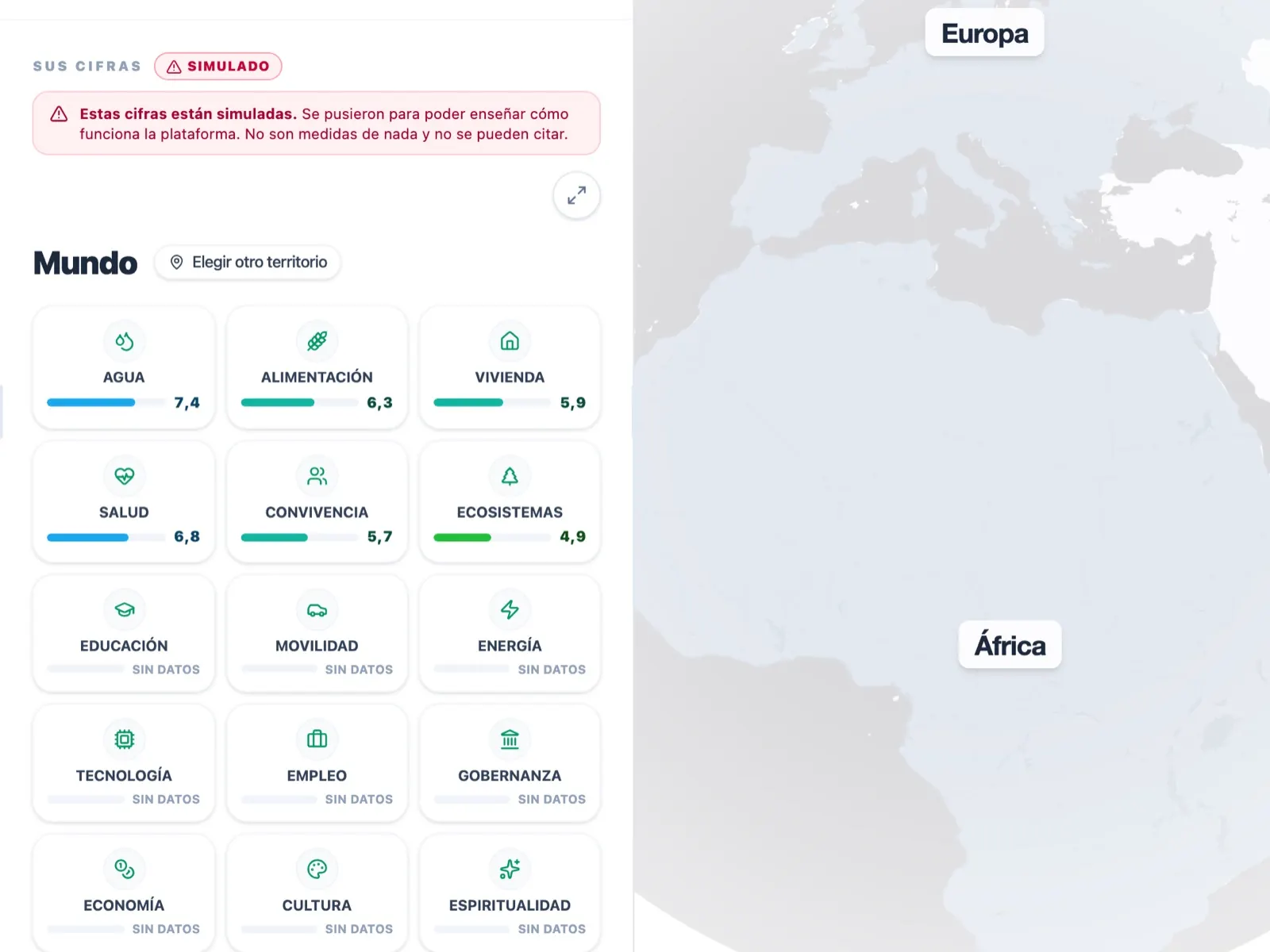
The platform's first rule is not to fabricate data. That is why the Humanity Indicators Map carries a warning in red: “These figures are simulated. They were added to show how the platform works. They do not measure anything and cannot be cited.”
- No data, shown in grey: a territory with no data is painted grey and never inherits the score of the level above. In world view, 9 of the 15 challenges are still marked “No data”.
- Tests in plain sight: the 179 municipalities of Madrid have simulated scores, and the 32 European countries have placeholder values.
- Hidden scores: since 28 October 2026, ratings only appear if someone asks to see them.
Scores from 1 to 10 for systems, in Spain for now
October 2026 brought the Evolution of Humanity: “how each of humanity's systems is doing in each territory, with a score from 1 (red, most urgent) to 10 (green, solved)”. Each system has a thermometer showing its level, its failures and how to move up a level.
- Indicators with a data sheet: each goal is measured by indicators with a code, unit, formula, source, threshold, frequency and verification method.
- Provisional: the assessments for Spain were chosen at random to test the system and are marked as provisional.
Politics as a system: six goals and a diagnosis of Spain
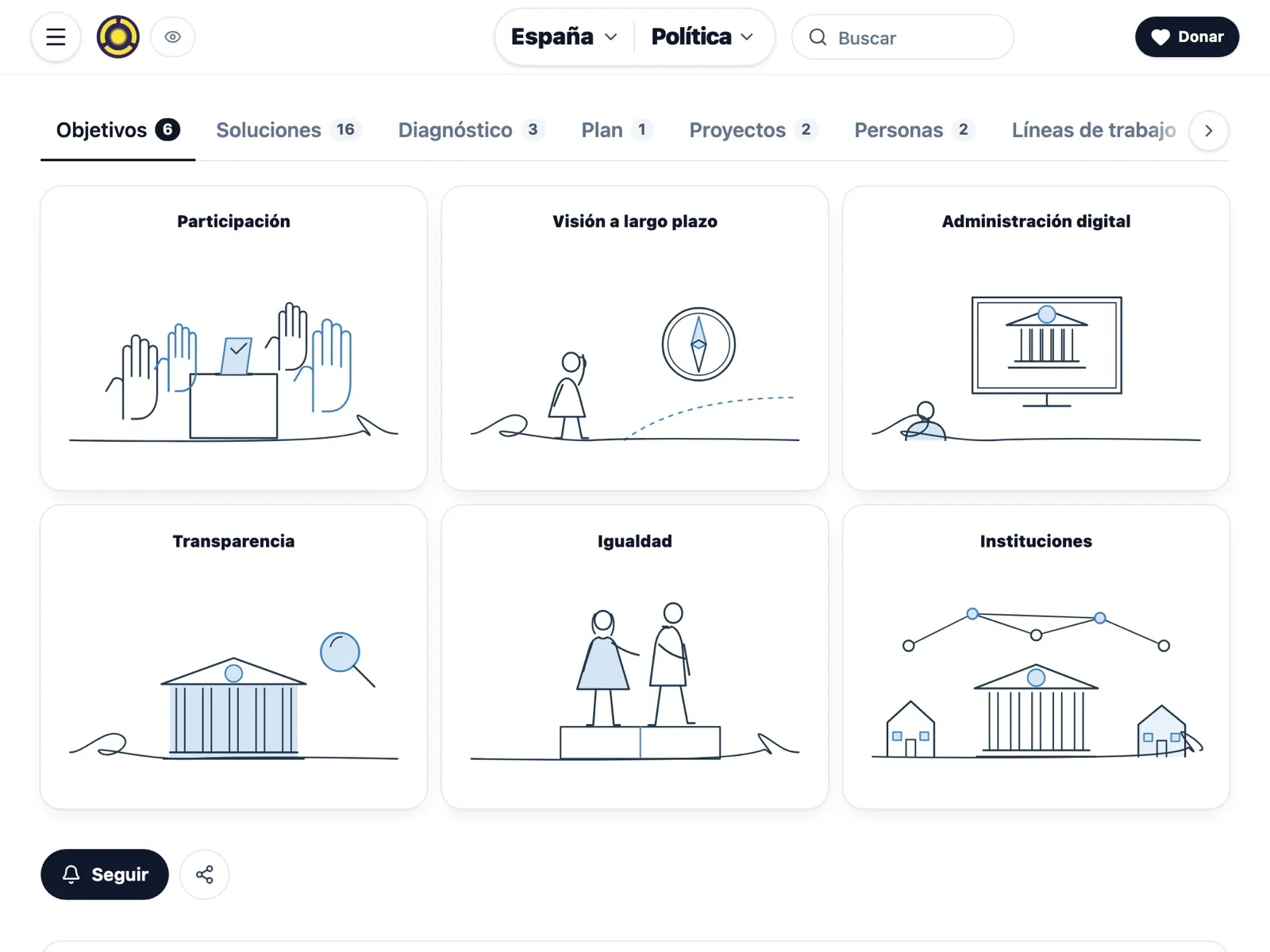
Politics, this project's field, is one of those systems. Its page on Humanity brings together six goals — participation, long-term vision, digital administration, transparency, equality and institutions — and 16 solutions.
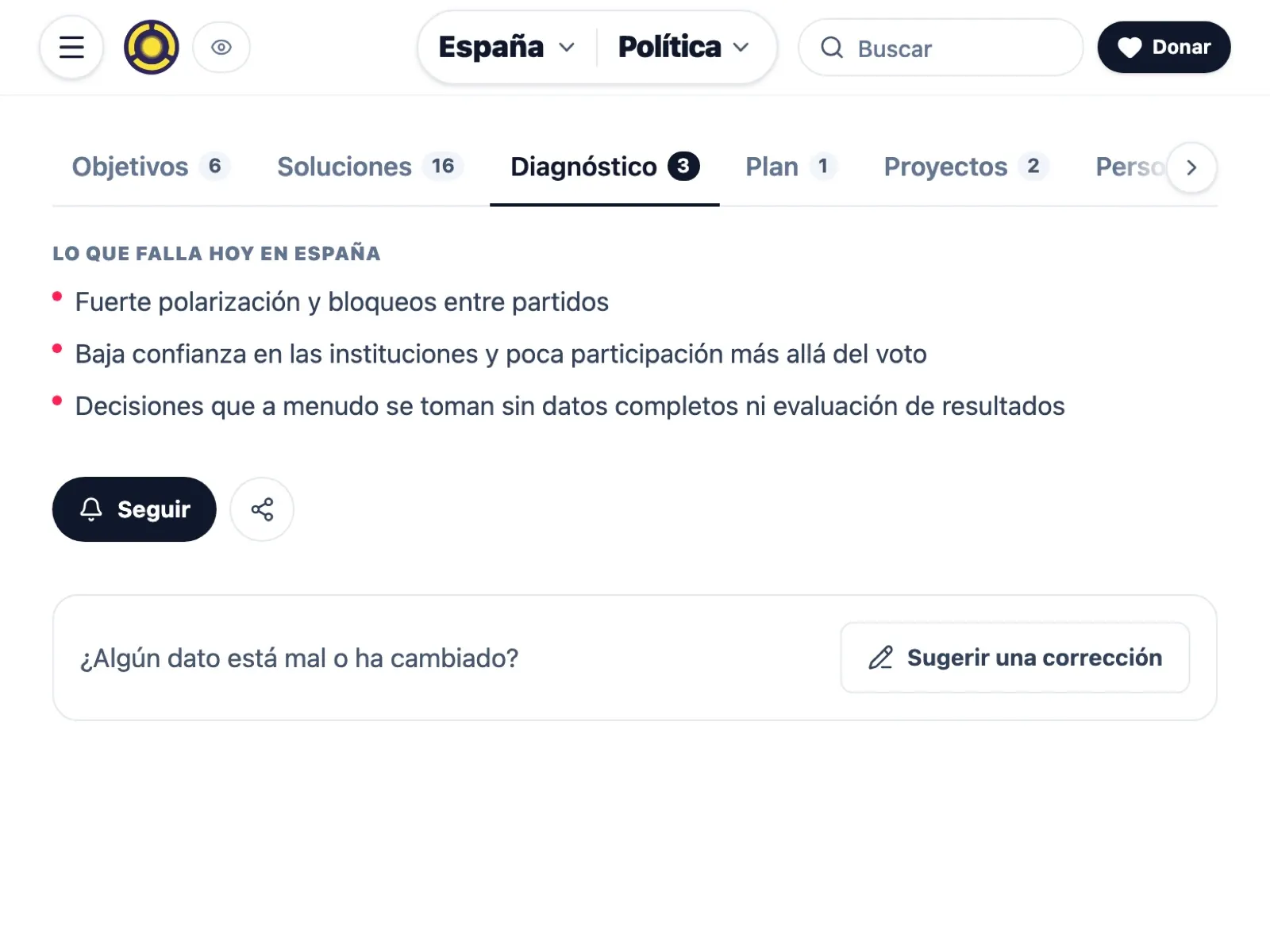
- Diagnosis: a tab sums up in three points “what is failing in Spain today” in politics, with no sources linked as yet.
- Institutions: the newest goal, dated 28 October 2026, measures alliances between states, the nation-state, regions and municipalities.
- People and projects: it links to political scientist María Roca, to Eugenio García-Calderón Huerta, to this project and to Solar Pedalling.
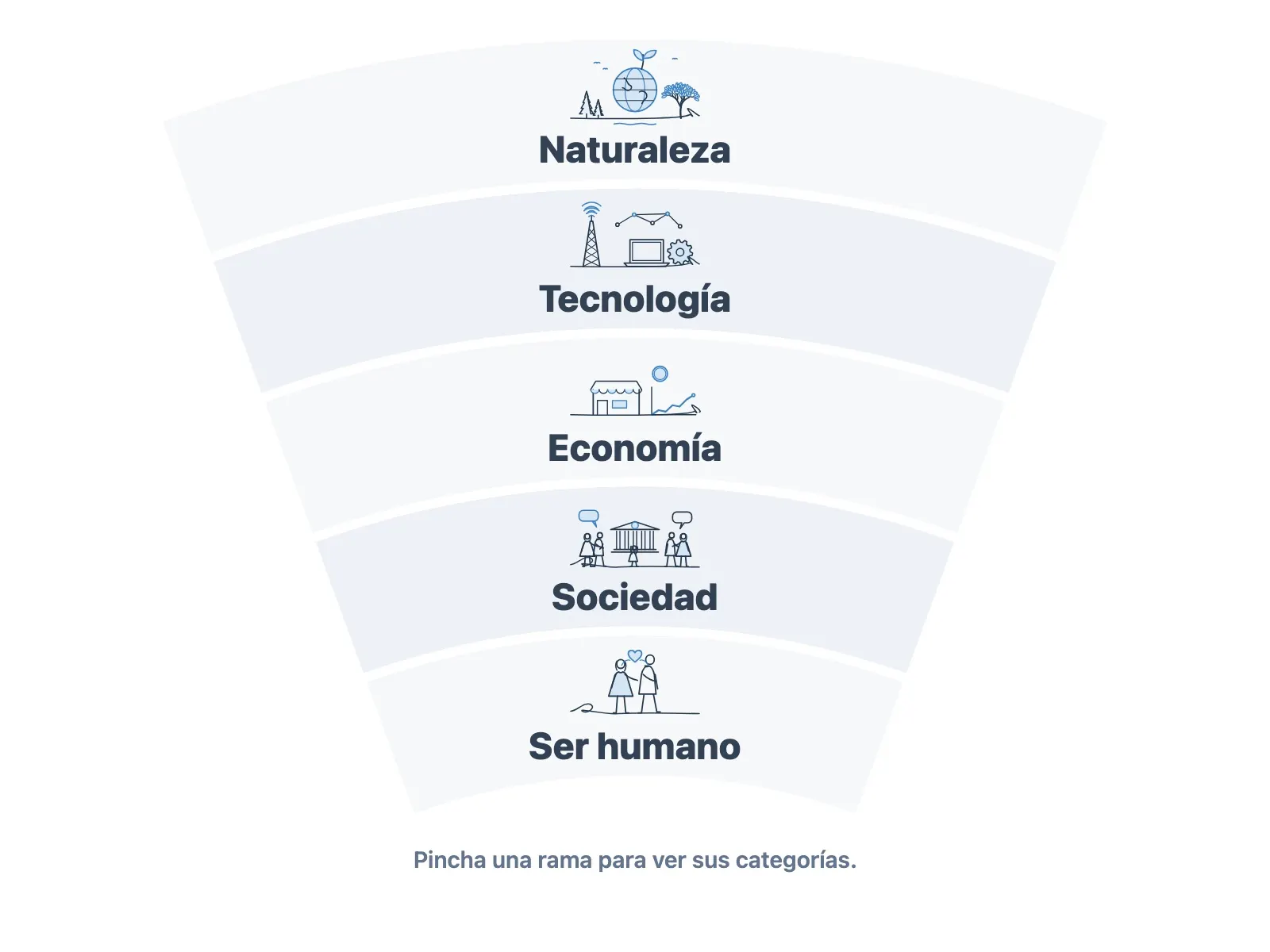
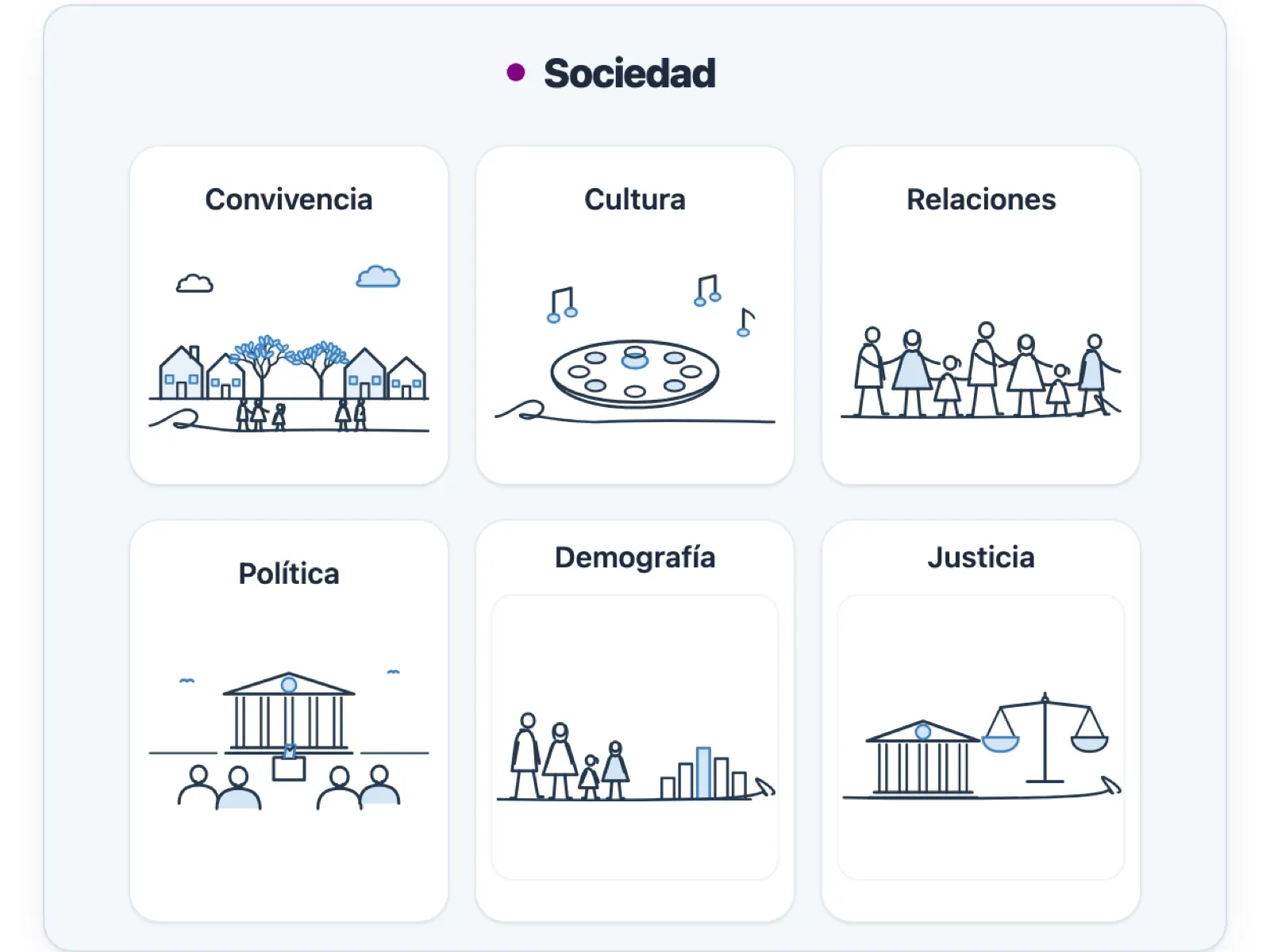
Systemic Evolution of Humanity: five branches, 30 categories and six views
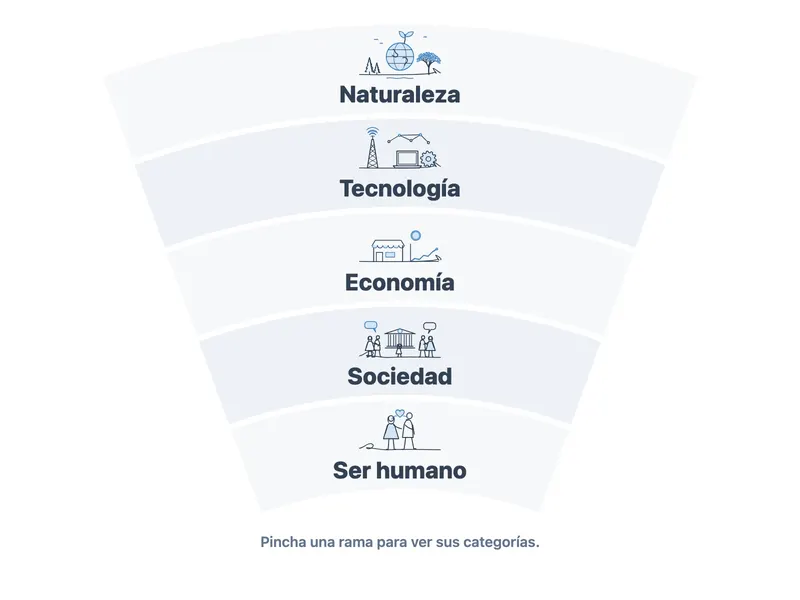
Since 5 November 2026, all that knowledge has lived at humanity.wiki/humanidad. It can be explored in six ways, all reading from the same databases.
- Circle, categories and map: the five branches, their 30 categories and Spain, region by region.
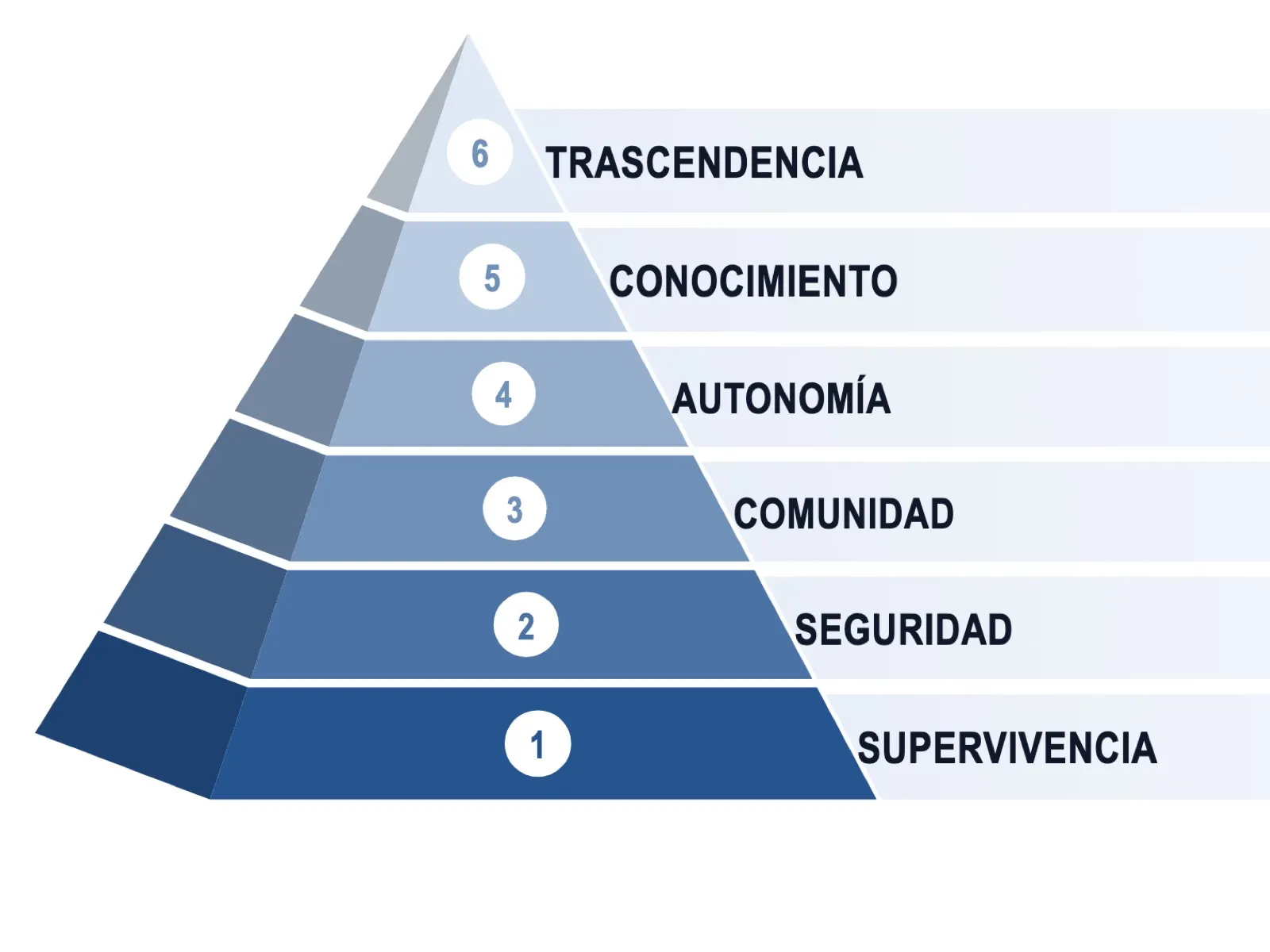
- Pyramid: six levels of need, from “sustaining life” to “giving meaning and contributing to something greater”.
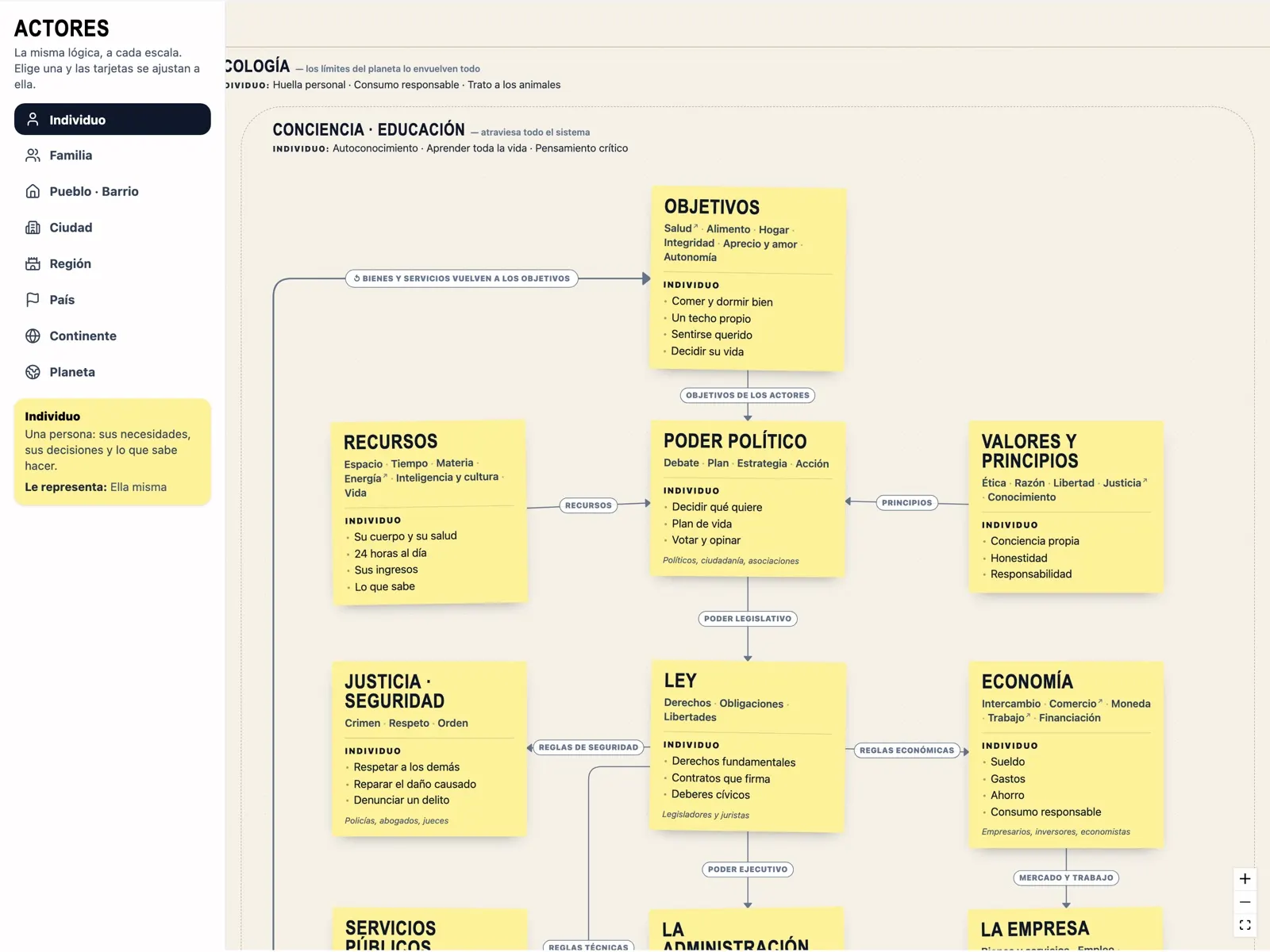
- Society: a whiteboard that runs from the individual to the planet with “the same logic, at every scale”.
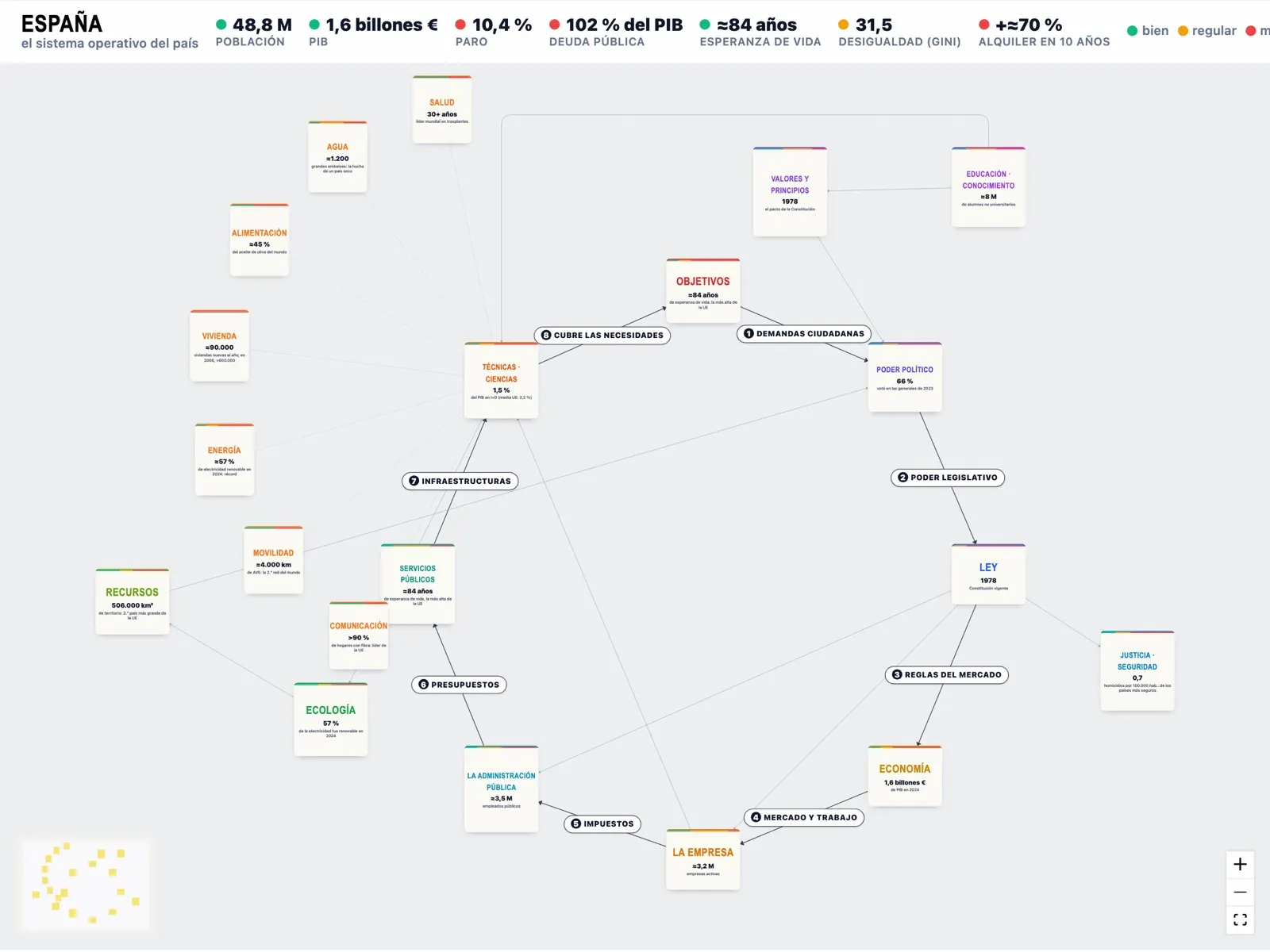
- Flow: “the country's operating system”, an eight-step cycle running from citizens' demands to meeting their needs.
Built with artificial intelligence, with the code open on GitHub
It is being built by one person who is not a programmer, working with artificial intelligence assistants that share no memory between sessions, explains the project README. That is why the repository keeps the specification, the decisions and every change.
- Public code: more than 2,300 changes in just over three months, still without an open licence: by default, all rights are reserved.
- A constitution: its rules require every entity to have an author and every change to leave a history: knowledge is never deleted by accident; it is archived.
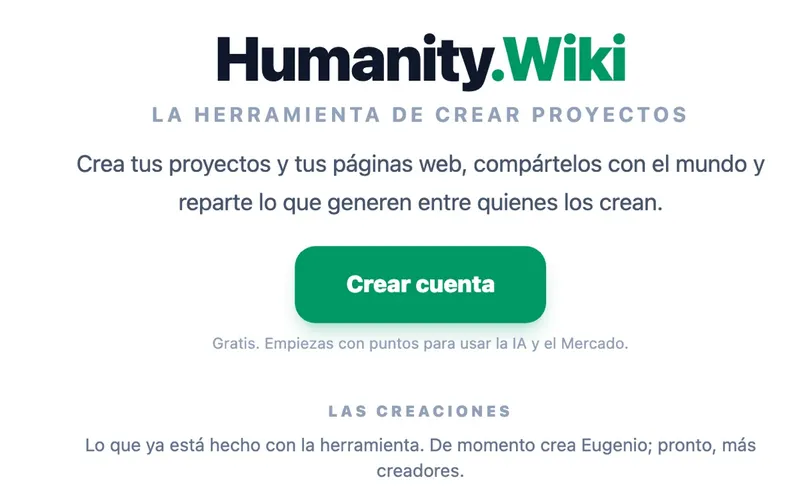
- The tool: humanity.wiki is also “the tool for creating projects”, described in Wiki Creator App.
- Built with it: this lab's website and the 3D models of the Aeromóvil and Organic Urban Design.
What's next: sourced data, a licence and more creators
- Sourced data: before code, the project is asking for cited indicators for territories that lack them.
- Governance: still pending on its roadmap are ensuring that unsourced data cannot be presented as data, peer review and a licence for the content.
- More creators: “For now, Eugenio creates; soon, more creators”, the home page announces.
Its commitment, from this early stage: that every figure should carry a source and a date and, when it has none, should say so.
Project links
 Humanity.Wiki — humanity.wiki
 Humanity · humanity.wiki — humanity.wiki
 humanity.wiki — humanity's knowledge, connected — GitHub · 02/08/2026